Other ID: KNKE BLM-Leg Bravo; CORPUS 23/29
Status: Completed
Organization(s): USGS, Woods Hole Coastal and Marine Science Center
Funding Program(s):
Principal Investigator(s): Gerald L. Shideler
Affiliate Investigator(s):
Information Specialist(s):
Data Type(s): Environmental Data: Temperature, Imagery: Photo, Sampling: Biology, Sampling: Geology, Environmental Data: Current, Seismics: Sub Bottom Profiler
Scientific Purpose/Goals: The overall objective of the program is to acquire the necessary geological, chemical, and biological baseline data for an environmental assessment of the South Texas Outer Continental Shelf. The data acquisition phase of the program is to be completed prior to leasing of the area for energy-resource development. The geological phase of this program is concerned primarily with determining the nature of sea floor sediments and substrate, as well as the nature of suspended sediment within the water column.
Vehicle(s):
Start Port/Location: Corpus Christi, TX
End Port/Location: Port Brownsville, TX
Start Date: 1974-11-11
End Date: 1974-11-25
Equipment Used: XBT, Camera- deep sea, Smith-MacIntyre grab, Gravity corer, Box corer, Current Drift Bottle, 3.5 kHz
Information to be Derived: Samples and chemical analysis; Bathymetric maps; Morphology;
Summary of Activity and Data Gathered: The 3.5 kHz seismic reflection profiles suggest some possible hydrocarbon seeps associated with faulting near the edge of the continental shelf. Ferro-manganese encrusted reef rock was obtained in 98 meters of water in the southeastern corner of the North Padre Island Area. A cursory inspection of XBT records suggests that the inner shelf waters are generally homogeneous, or else exhibit slightly increasing temperature gradients. This may possibly be attributed to pronounced mixing associated with the high wind velocities and sea state conditions experienced during the cruise. In contrast, the middle and outer shelf waters exhibit increasingly higher degrees of thermal stratification with increasing water depth. Relatively warm surface water masses generally overlie colder deeper masses, with well-defined thermoclines. There is also some indication of a relatively warm intermediate-depth layer at some of the deeper stations. The bottom sediments throughout most of the Texas OCS area that was sampled during BLM Leg Bravo consist of grayish-olive or olive-brown mud. Sand was found to be a minor constituent, and gravel detritus was not observed in any significant quantity. Water samples: 49 (3 at each of 13 stations plus 10 for quality control); XBTs: 44 stations; Bottom photographs: 19 stations; Smith-MacIntyre grab samples: 71 stations (6 subsamples at each); Gravity cores: 26 stations; Box cores: 39 stations; Samples for organic analyses: 34 stations; Benthic faunal collections: 110 (from grabs and box cores); Drift bottle casts: 24 stations; Seismic reflection profiles (3.5 kHz) and bathymetry: all stations.
Staff: Gerald L. Shideler, Robert E. Miller, Michael Dorsey, Ronald J. Miller, Robert Vitaglione, Kenneth Roberts
Affiliate Staff:
Michael English (Navigator - Decca)
Robert Trice (Navigator - Decca); Rod Jackson (Geological Field Assistant)
Michael Coleman (Geological Field Assistant)
Douglas Watson (Geological Field Assistant)
Steven Rabalais (Geological Field Assistant)
Ted Nehrkorn (Geological Field Assistant)
Notes:
Project = Marine geological survey of the South Texas OCS, Marine geological survey of the South Texas OCS
Location:
south Texas outer continental shelf, Texas, United States, Gulf of Mexico, North America, North Atlantic;
| Boundaries | |||
|---|---|---|---|
| North: 28.5 | South: 26 | West: -97 | East: -95.3 |
Platform(s):
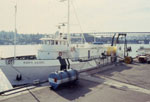 Kana Keoki |
Flores, R.M., and Shideler, G. L., 1978, Factors controlling heavy-mineral variations on the South Texas outer continental shelf, Gulf of Mexico: Journal of Sedimentary Research, v. 48 no. 1, URL: http://jsedres.sepmonline.org/cgi/reprint/48/1/269.
Shideler, G.L., 1988, Heavy-mineral placer potential map of the U.S. continental shelf, western and northern Gulf of Mexico: U.S. Geological Survey Miscellaneous Field Studies Map 2037, 1 sheet, URL: https://pubs.er.usgs.gov/publication/mf2037.
Shideler, G.L., and Flores, Romeo M., 1976, Maps showing distribution of heavy minerals on the south Texas outer continental shelf: U.S. Geological Survey Miscellaneous Field Studies Map 841, 1 sheet, URL: https://pubs.er.usgs.gov/publication/mf841.
| Title | Survey Equipment | Description |
|---|---|---|
| Cruise report | (document not focused on specific equipment) | Chief Scientist's cruise report describing ship movement, personnel, equipment and data acquisition notes, area map, etc. |
| Survey Equipment | Survey Info | Data Type(s) | Data Collected |
|---|---|---|---|
| XBT | --- | Temperature | |
| Camera- deep sea | --- | Photo | |
| Smith-MacIntyre grab | --- | Biology Geology | |
| Gravity corer | --- | Geology | |
| Box corer | --- | Biology Geology | |
| Current Drift Bottle | --- | Current | |
| 3.5 kHz | --- | Sub Bottom Profiler |
