Other ID: FAY 009
Status: Completed
Organization(s): USGS, Woods Hole Coastal and Marine Science Center
Funding Program(s):
Principal Investigator(s): Henry Berryhill
Affiliate Investigator(s):
Information Specialist(s):
Data Type(s): Seismics: Sparker, Location-Elevation: Navigation
Scientific Purpose/Goals: Cruise was devoted to acquisition of high quality high-resolution seismic reflection data and was a continuation of Leg 008 (FA 75030) following the same objectives: application of the land-use concept to the sea floor within Texas territorial waters (10.3 miles); acquisition of a detailed and integrated base of geologic data as background for the investigation of a variety of shoreline and inner shelf needs including shoreline engineering, power plant sitings, pipeline corridors, port sitings and determination of sediment movement and sand budget; general environmental assessment; and as a base for selecting sites for a variety of sampling types including grab, piston, vibracore and biological.
Vehicle(s):
Start Port/Location:
End Port/Location:
Start Date: 1975-12-14
End Date: 1975-12-18
Equipment Used: Del Norte 26 sparker, Lorac Positioning System
Information to be Derived: Morphology;
Summary of Activity and Data Gathered: Records obtained were of good to excellent quality. Several tie lines across the shelf were of unusually high quality, resolution of such detail that several key reflections representing Pleistocene low stands of the sea can be traced without equivocation from shelf edge to the 20 ft. isobath, the inner terminus of the lines. Minisparker: 800 km; 3.5 kHz: 300 km. Combined totals for Legs 008 (FA 75030) and 009 (FA 75033): Minisparker: 4140 km; 3.5 kHz: 1485 km. The Minisparker array was towed on starboard, the hydrophone streamer 150 ft. astern of the sparker tip. Pulse generator was fired at a 1.0 rep. rate. Signal from the hydrophones was split and transmitted through 2 signal processors to recorders at 1.0 sec. sweep and 0.5 sec. sweep. With the 3.5-7.0 kHz system, the 3.5 kHz range was used exclusively, recorded at a sweep rate of 0.5 sec. Time variable gain was used exclusively.
Staff: Henry Berryhill, Ronald J. Miller, Robert Vitaglione, Carroll Pyle
Affiliate Staff:
Scott Heald
Felicity Ohrm; Joe McGowan - Texas Bureau of Economic Geology; John Chin - U. Texas; Sonny Andrus - navigator
LORAC; David Botts - navigator
LORAC
Notes: Original Center People field contained: Henry Berryhill, Jr. - Ch. Sci., Ronald Miller - Watch leader, Robert Vitaglione, Cary Pyle - Watch Leader, Scott Heald, and Felicity Ohrm.
Project = Texas Co-op, Texas Co-op
Location:
South Texas inner continental shelf, Texas, Gulf of Mexico, United States, North America, North Atlantic;
| Boundaries | |||
|---|---|---|---|
| North: 29 | South: 25 | West: -97.5 | East: -95 |
Platform(s):
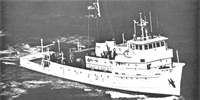 Fay |
| Title | Survey Equipment | Description |
|---|---|---|
| Cruise report | (document not focused on specific equipment) | Chief Scientist's cruise report including personnel, cruise description, and comments on data acquired. |
| Survey Equipment | Survey Info | Data Type(s) | Data Collected |
|---|---|---|---|
| Del Norte 26 sparker | --- | Sparker | |
| Lorac Positioning System | --- | Navigation |
