Other ID: Oceanus 477
Status: Completed
Organization(s): USGS, Woods Hole Coastal and Marine Science Center
Funding Program(s):
Principal Investigator(s): Bradford Butman, Patrick Dickhudt
Affiliate Investigator(s): Bruce Keafer (Woods Hole Oceanographic Institution)
Information Specialist(s): Bradford Butman
Data Type(s): Geochemical: Experiments (geochemical), Imagery: Photo, Imagery: Video, Location-Elevation: Navigation, Sampling: Biology, Sampling: Geology
Scientific Purpose/Goals: Overall objective of cruise is to map distribution of Alexandrium cysts in surficial sediments of western Gulf of Maine (approximately 112 stations). USGS objective is to obtain undisturbed cores using the slow corer and conduct erosion measurements using University of Maryland Gust Erosion Microcosm System (UGEMS) at approximately 10 stations.
Vehicle(s):
Start Port/Location: Woods Hole, MA
End Port/Location: Woods Hole, MA
Start Date: 2011-10-24
End Date: 2011-11-04
Equipment Used: Gust Erosion Microcosm System (GEMS), Video camera - deep sea, Digital camera, GPS (wh), Craib corer, Grab sampler, Slow corer
Information to be Derived: Grain size analysis;Physical property data;
Summary of Activity and Data Gathered: This was a 12-day cruise to the Gulf of Maine on RV Oceanus carried out cooperatively by WHOI and the USGS. The primary objective of the WHOI investigators was to map the concentration of red tide cysts in the surficial sediments. Samples of the surficial sediments were obtained at ~100 stations; samples were sieved and preserved for counting of cysts ashore. A subsample was saved for analysis of surficial sediment texture. The primary USGS objective was to measure sediment erodability at selected locations. Replicate cores using the USGS slow corer were obtained at 10 locations and analysis was carried out onboard using UGEMS. Nearly all the planned sampling stations were occuppied. GEMS analysis was carried out on 20 cores (10 stations). A video camera mounted on the slow corer provided very useful insight into core sampling under varing conditions (sea state, lowering rate, sediment texture). We sought refuge from a very intense NE storm in Bar Harbor, ME from the evening of October 29 to the morning of October 31. Waves in Jordan basin reached ~28' during this storm. This was the next to last cruise for WHOI's RV Oceanus, ending her 37-year career at WHOI.
Staff: Sandy Baldwin, Katherine McMullen
Affiliate Staff:
10 others from WHOI and elsewhere
Notes: Cruise led by Woods Hole Oceanographic Institution, Bruce Keafer Chief Scientist
Project = Models for Changing Coastal Env,
Location:
Gulf of Maine, United States, North America, North Atlantic;,
| Boundaries | |||
|---|---|---|---|
| North: 45.8288 | South: 41.37681 | West: -71.543 | East: -64.95117 |
Platform(s):
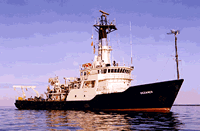 Oceanus |
Butman, B., Aretxabaleta, A.L., Dickhudt, P.J., Dalyander, P.S., Sherwood, C.R., Anderson, D.M., Keafer, B.A., and Signell, R.P., 2014, Investigating the importance of sediment resuspension in Alexandrium fundyense cyst population dynamics in the Gulf of Maine: Deep-Sea Research Part II—Topical Studies in Oceanography, vol. 103, p. 79-95, https://doi.org/10.1016/j.dsr2.2013.10.011.
| Title | Survey Equipment | Description |
|---|---|---|
| Cruise report | (document not focused on specific equipment) | Chief Scientist's cruise report including objective, summary of work, personnel, daily narrative, tabulated information, trackmap with core locations, notes on individual coring locations. |
| Core log | (document not focused on specific equipment) | OC477, scanned USGS slow corer logsheets including station location, water depth, comments. |
| UGEMS log | Gust Erosion Microcosm System (GEMS) | OC477, scanned UGEMS logsheets including station comments. |
| Filter log | (document not focused on specific equipment) | OC477, scanned filter logsheets including comments. |
| Sample log | (document not focused on specific equipment) | OC477, scanned cyst sample logsheets |
| Survey Equipment | Survey Info | Data Type(s) | Data Collected |
|---|---|---|---|
| Gust Erosion Microcosm System (GEMS) | --- | Experiments (geochemical) | 2011-047-FA-SC-001-02 (Sediment texture analyses of surface sediment samples obtained using Craib corer and UGEMS samples obtained using USGS slower corer. The UGEMS samples obtained from top of core after erosion.
Grain-size analysis: Lab #s AZ066 through AZ191) |
| Video camera - deep sea | --- | Video | |
| Digital camera | --- | Photo | |
| GPS (wh) | --- | Navigation | 2011-047-FA-LN-001 (Table of latitude, longitude, and water depth for sample stations on Oceanus cruise 477.) |
| Craib corer | --- | Geology | 2011-047-FA-SC-001-01 (Sediment texture analyses of surface sediment samples obtained using Craib corer and UGEMS samples obtained using USGS slower corer. The UGEMS samples obtained from top of core after erosion.
Grain-size analysis: Lab #s AZ066 through AZ191) |
| Grab sampler | --- | Biology Geology | |
| Slow corer | --- | Geology | 2011-047-FA-NL-005 (OC477, scanned cyst sample logsheets) 2011-047-FA-NL-002 (OC477, scanned USGS slow corer logsheets) 2011-047-FA-NL-003 (OC477, scanned UGEMS logsheets) 2011-047-FA-NL-004 (OC477, scanned filter logsheets) |
